Every genomics team knows the moment: the VCF files have arrived, millions of variant calls across dozens of samples, and the real work hasn't started yet.
Before anyone can ask an interesting biological question, someone has to write the queries. Which fields does this caller use for quality? How is allele fraction encoded? Why does this sample have twice as many variants as that one? For most teams, that means hours of custom SQL and scripts, a separate pipeline for every variant caller, and findings that live in someone's notebook rather than anywhere the team can trace.
The bottleneck in variant analysis isn't the sequencing. It's the querying.
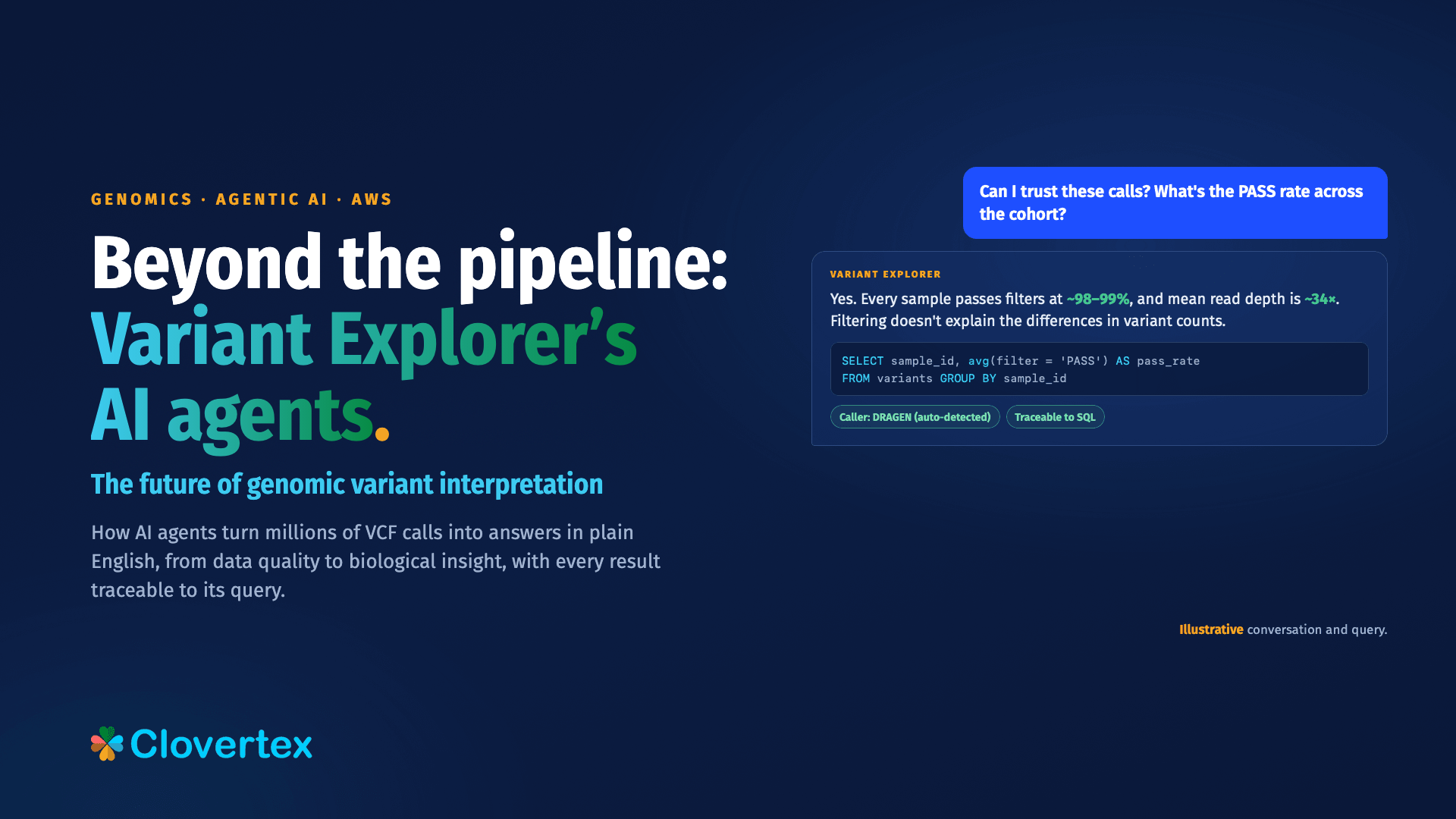
Variant Explorer is Clovertex's AI-native platform for genomic variant analysis. It loads your VCF files into Amazon Athena on AWS S3 Tables, detects which tool called the variants, and lets bioinformaticians, clinicians and researchers explore their data in plain English, through a chat and an interactive analytics dashboard, with no SQL required.
How it worksFrom VCF upload to validated insight
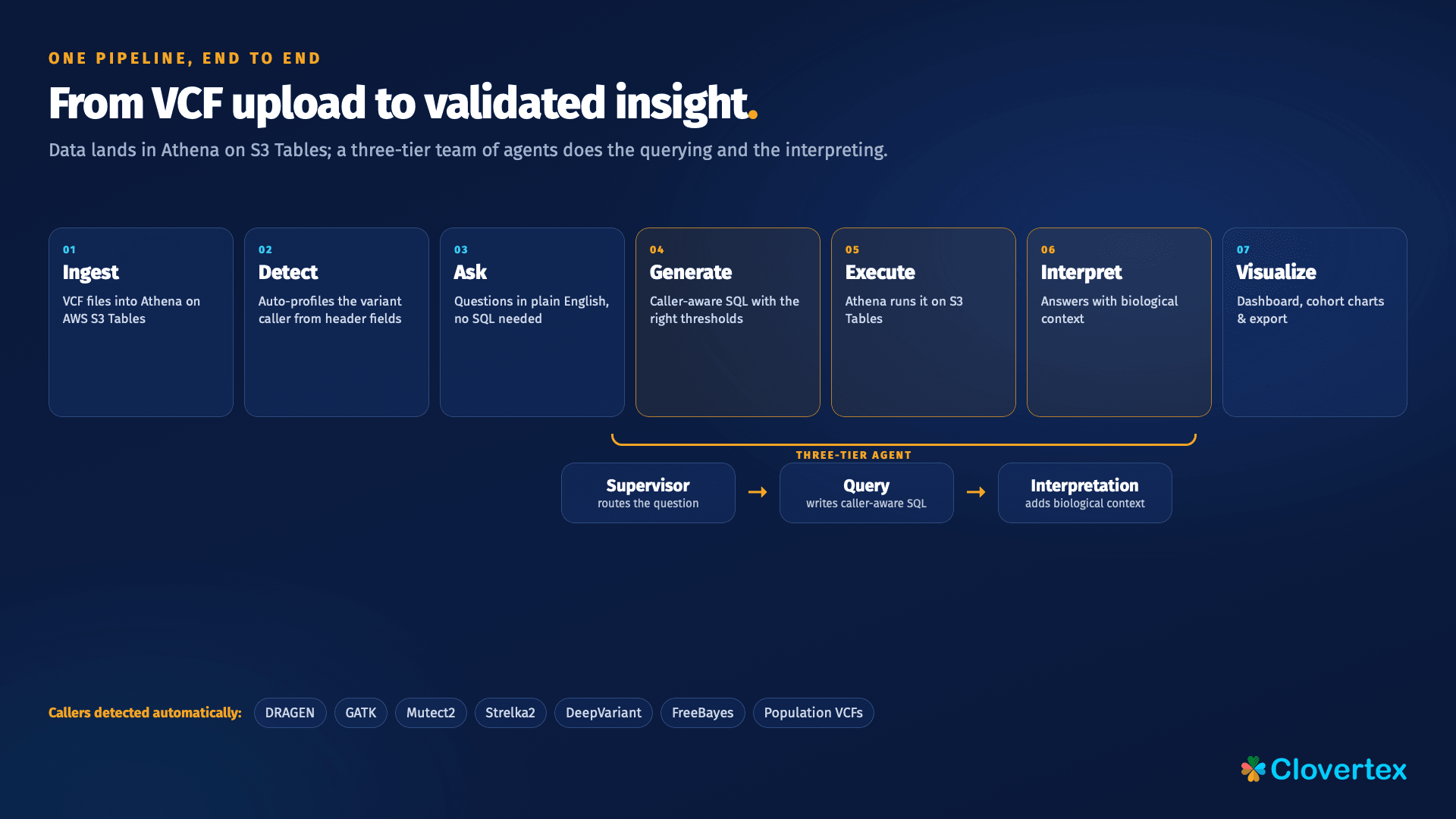
Behind the conversation is a three-tier team of AI agents:
Supervisor agent
Understands the question and routes it to the right specialist.
Query agent
Writes caller-aware SQL and runs it in Athena on S3 Tables.
Interpretation agent
Turns the result into an answer with biological context.
Every answer has a receipt
Each response is tied to the exact SQL query and data source behind it.
Built for the messiness of real VCFs
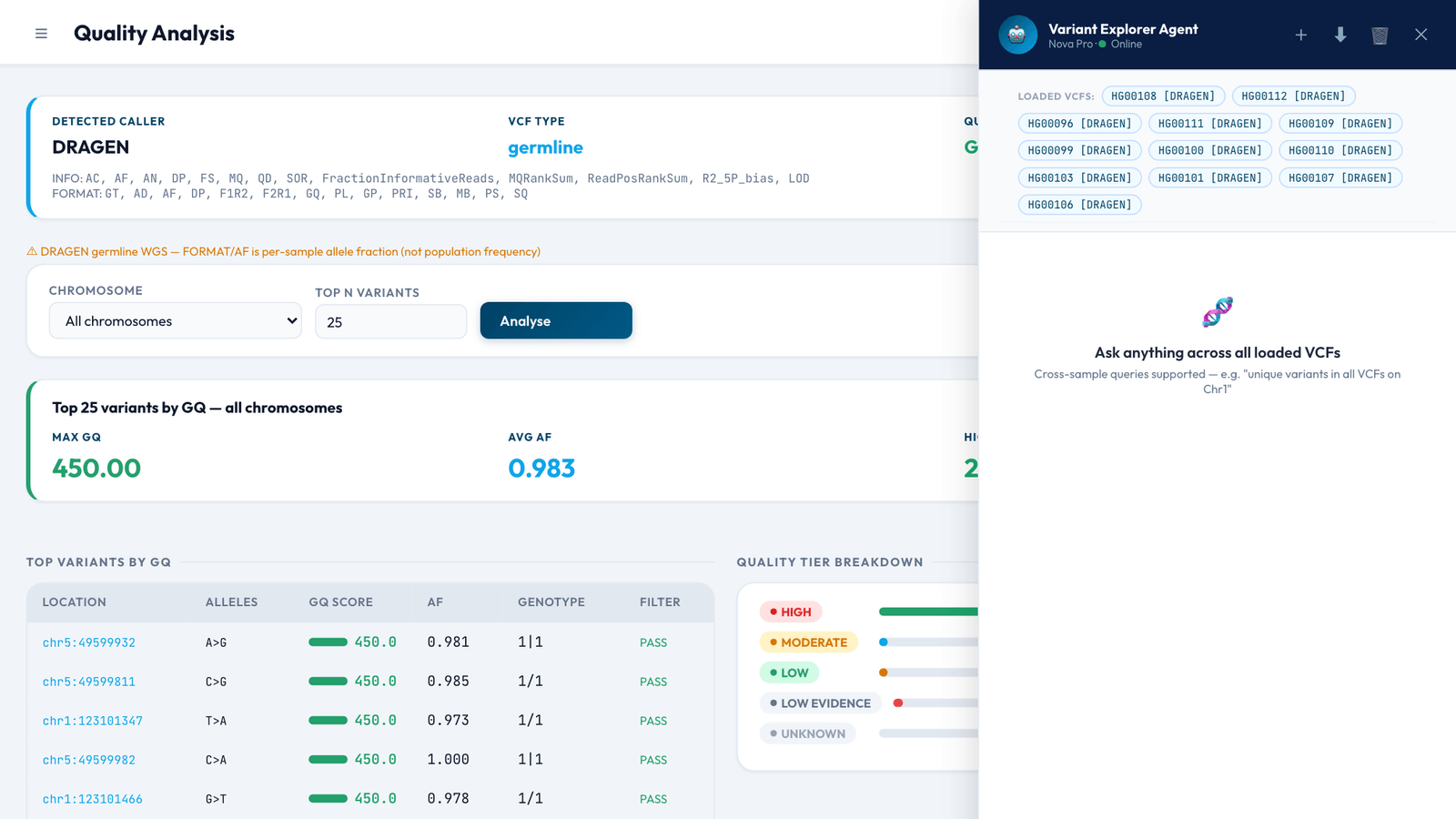
Every caller does things differently. Variant Explorer's agents inspect each file's header and INFO/FORMAT fields to identify the caller automatically (DRAGEN, GATK, Mutect2, Strelka2, DeepVariant, FreeBayes and population VCFs) and apply the right quality thresholds and allele-fraction logic. INFO and FORMAT fields are stored as map columns in a single Athena table, so supporting a new caller is a configuration change, not a schema rebuild.
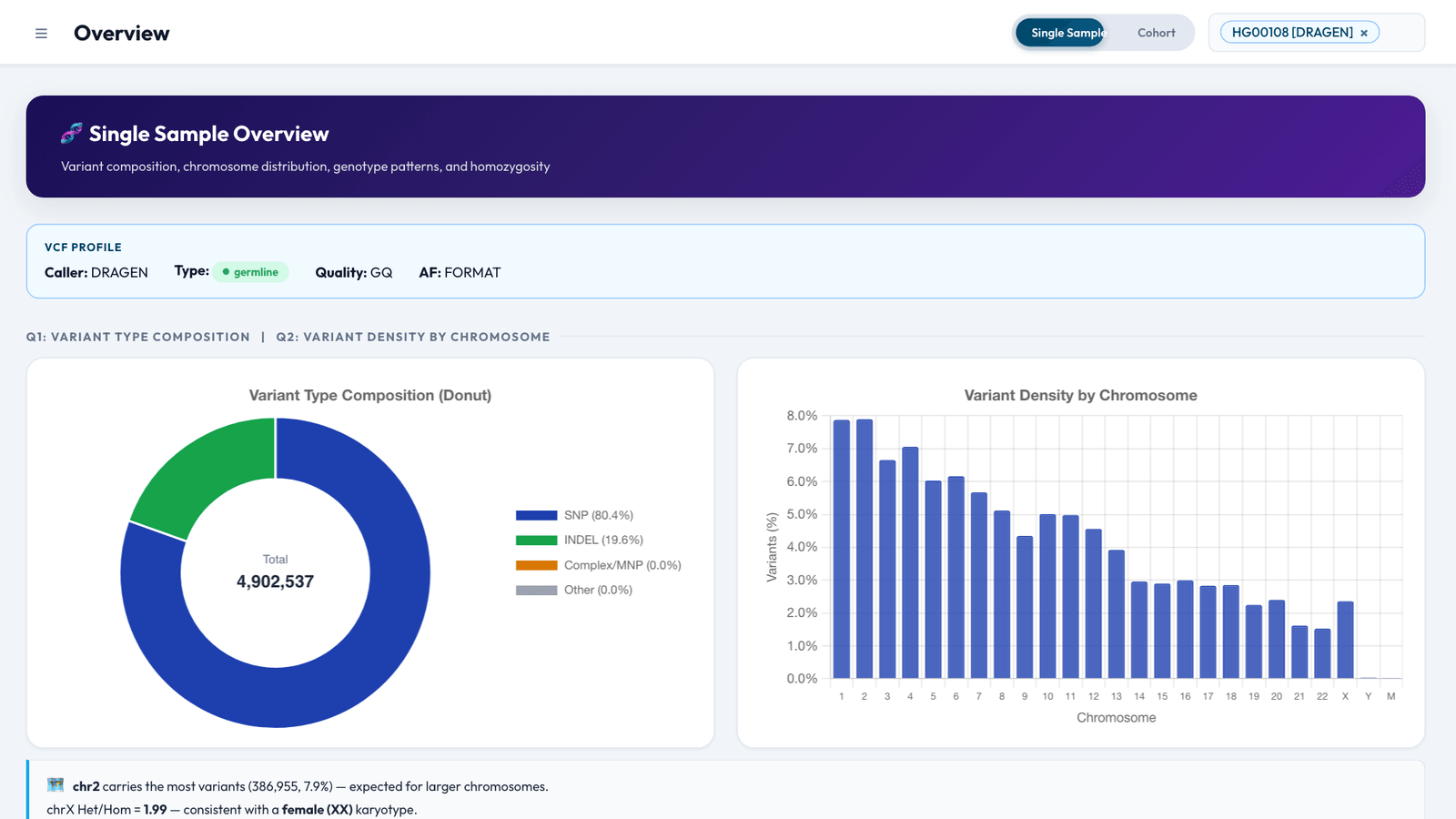
Here's what that looks like inside the application:
In practiceTrust the data first, then read the biology
Researchers don't start by asking "which plot should I show?" They start with a scientific concern: can I trust these calls enough to compare samples? Only once the answer is yes does the next question follow: what kind of variation defines this cohort?
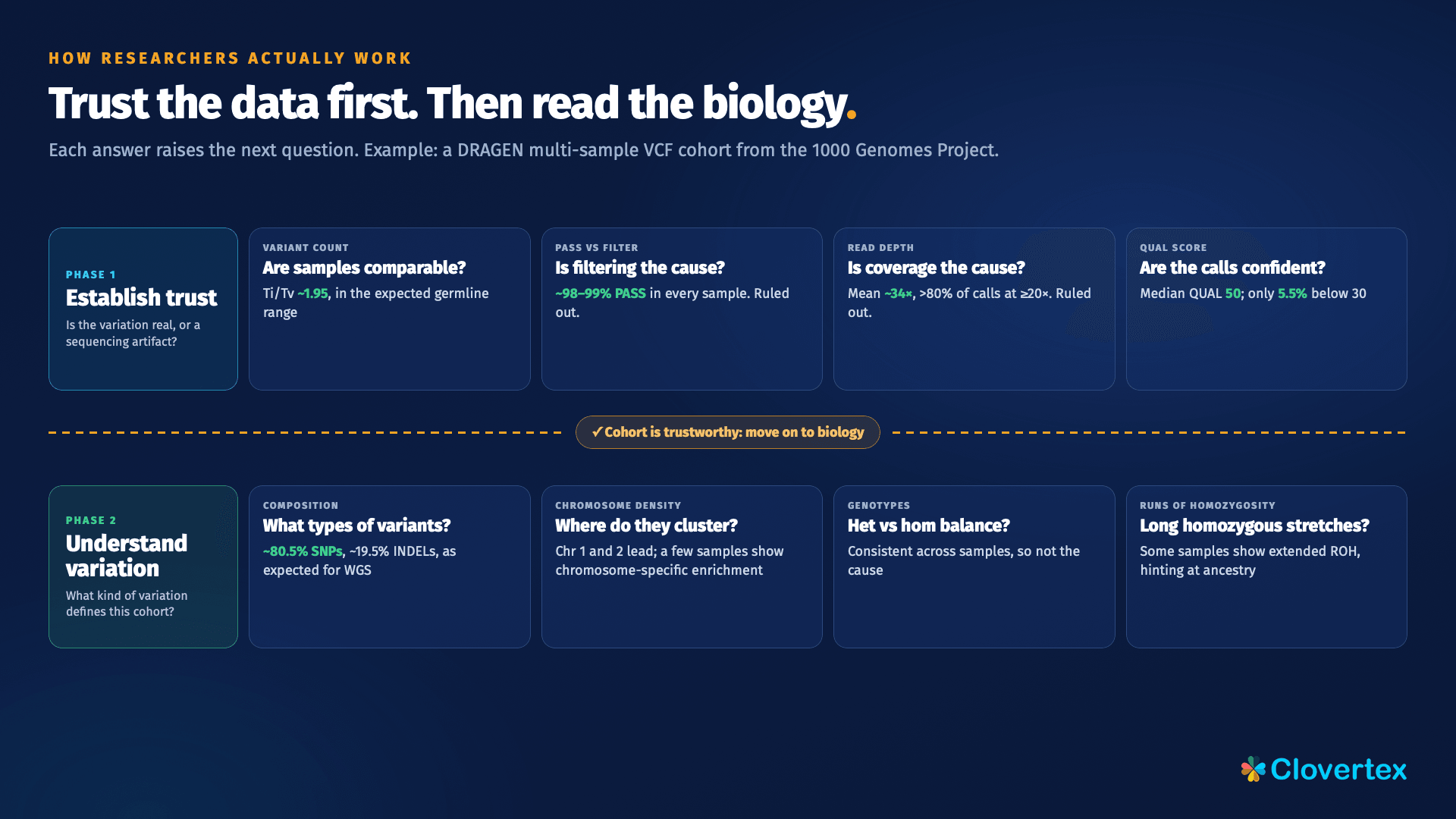
Here's what that looks like on a real dataset: a DRAGEN multi-sample VCF cohort from the 1000 Genomes Project, analysed in Variant Explorer.
Phase 1Can we trust this cohort?
Quality assessment comes first. Before comparing genomes, you need to know whether the variation you see reflects real biology or artifacts of sequencing, alignment or variant calling. Each step answers one question and rules out one explanation:
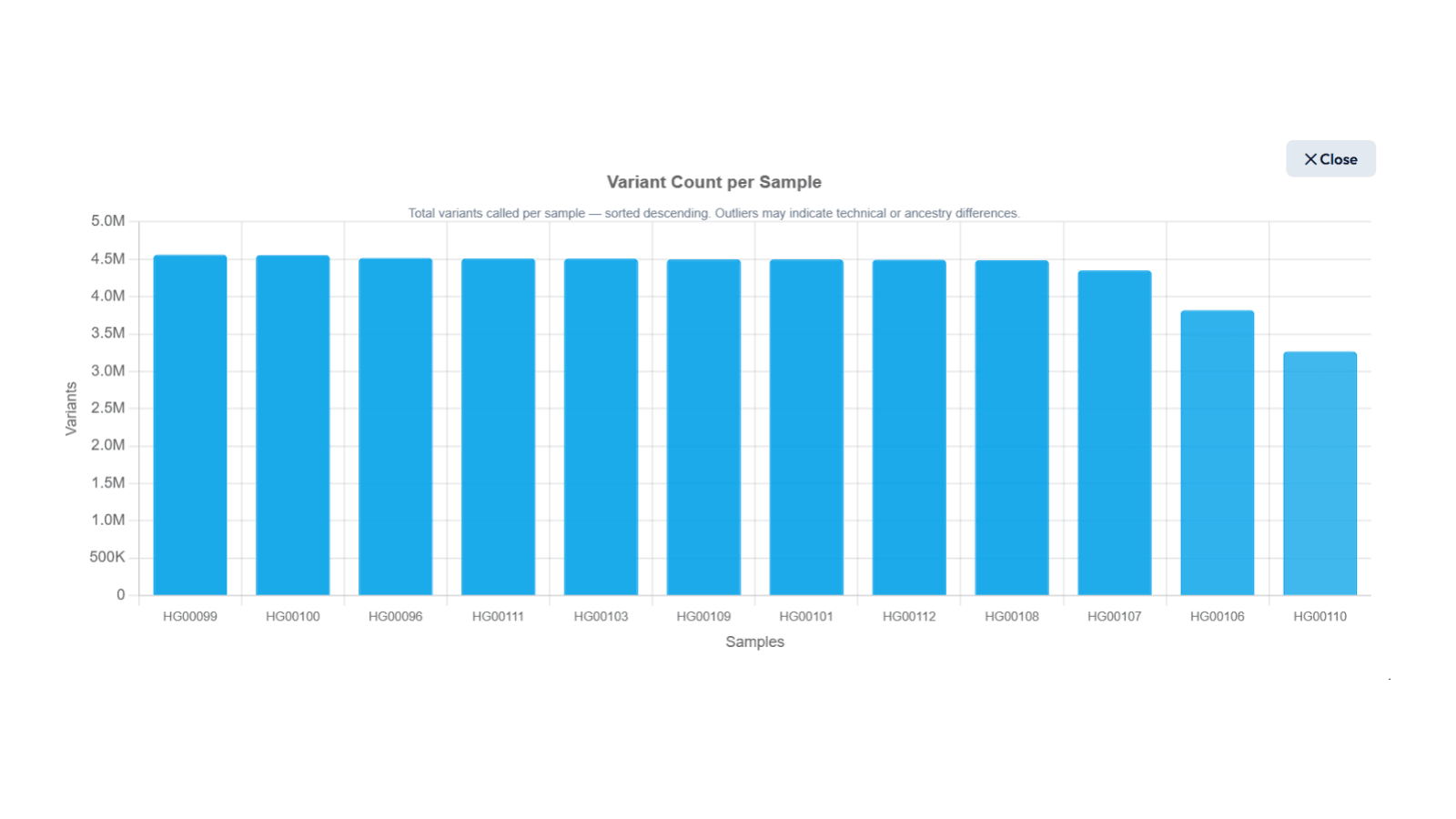
- Variant count per sample. Counts vary across samples, but the average transition/transversion (Ti/Tv) ratio of about 1.95 sits in the expected range for germline whole-genome sequencing. So are the high and low counts biology, or poor calls?
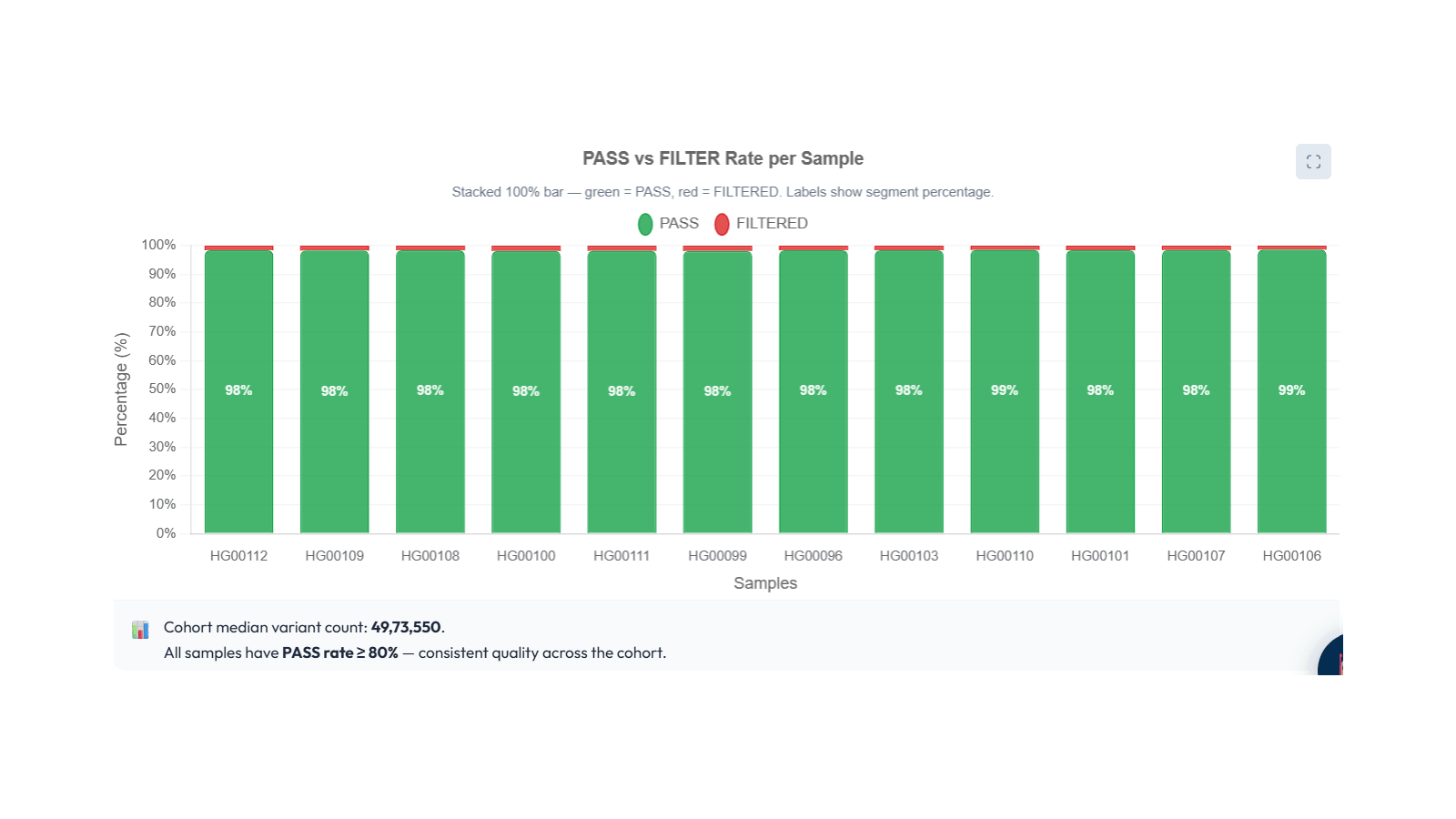
- PASS vs. FILTER. Every sample passes quality filters at roughly 98–99%, including the ones with unusual counts. Poor-quality calls aren't the explanation.
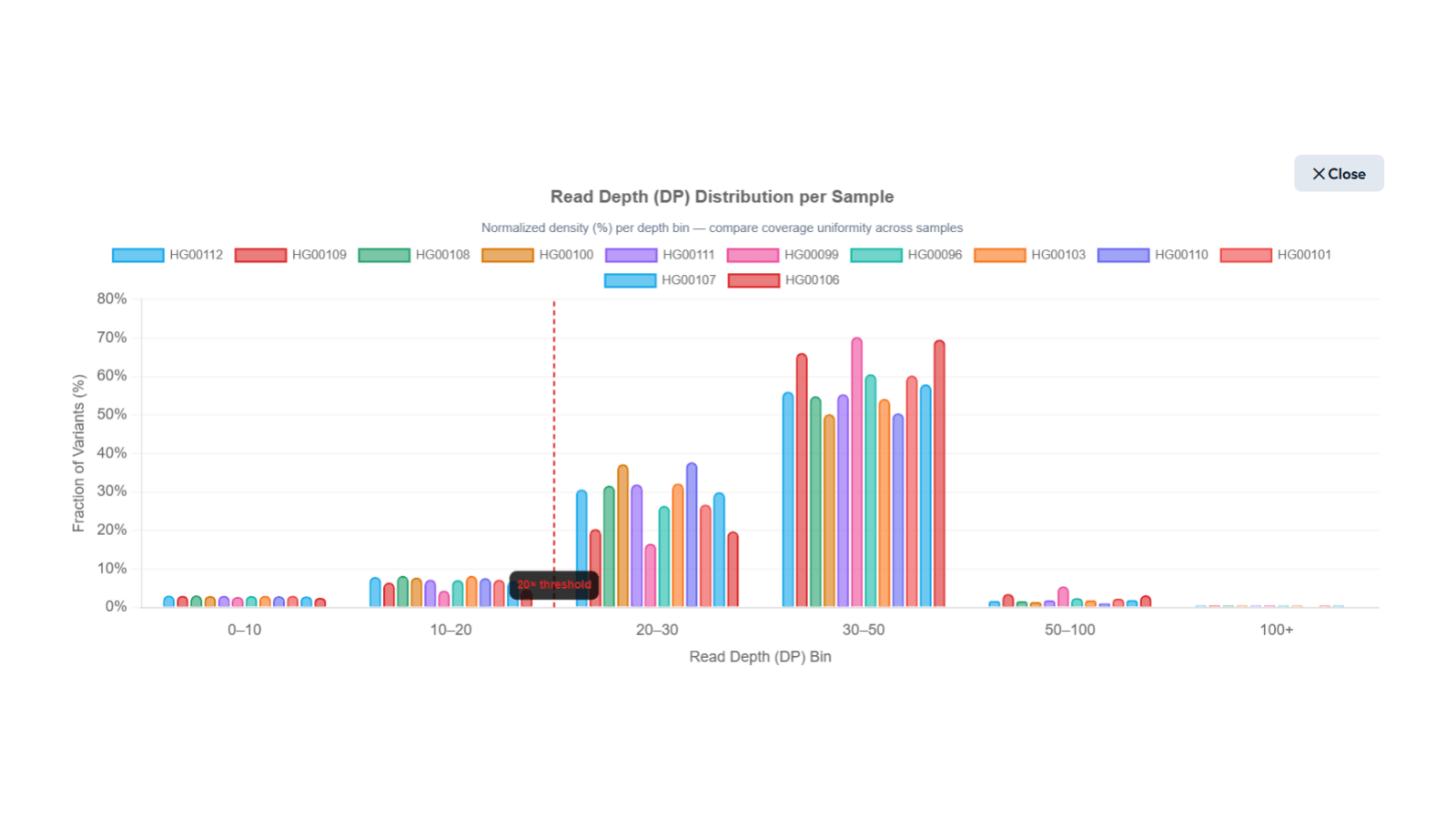
- Read depth. Average depth is about 34×, with more than 80% of variants in every sample at 20× or higher. Coverage isn't the explanation either.
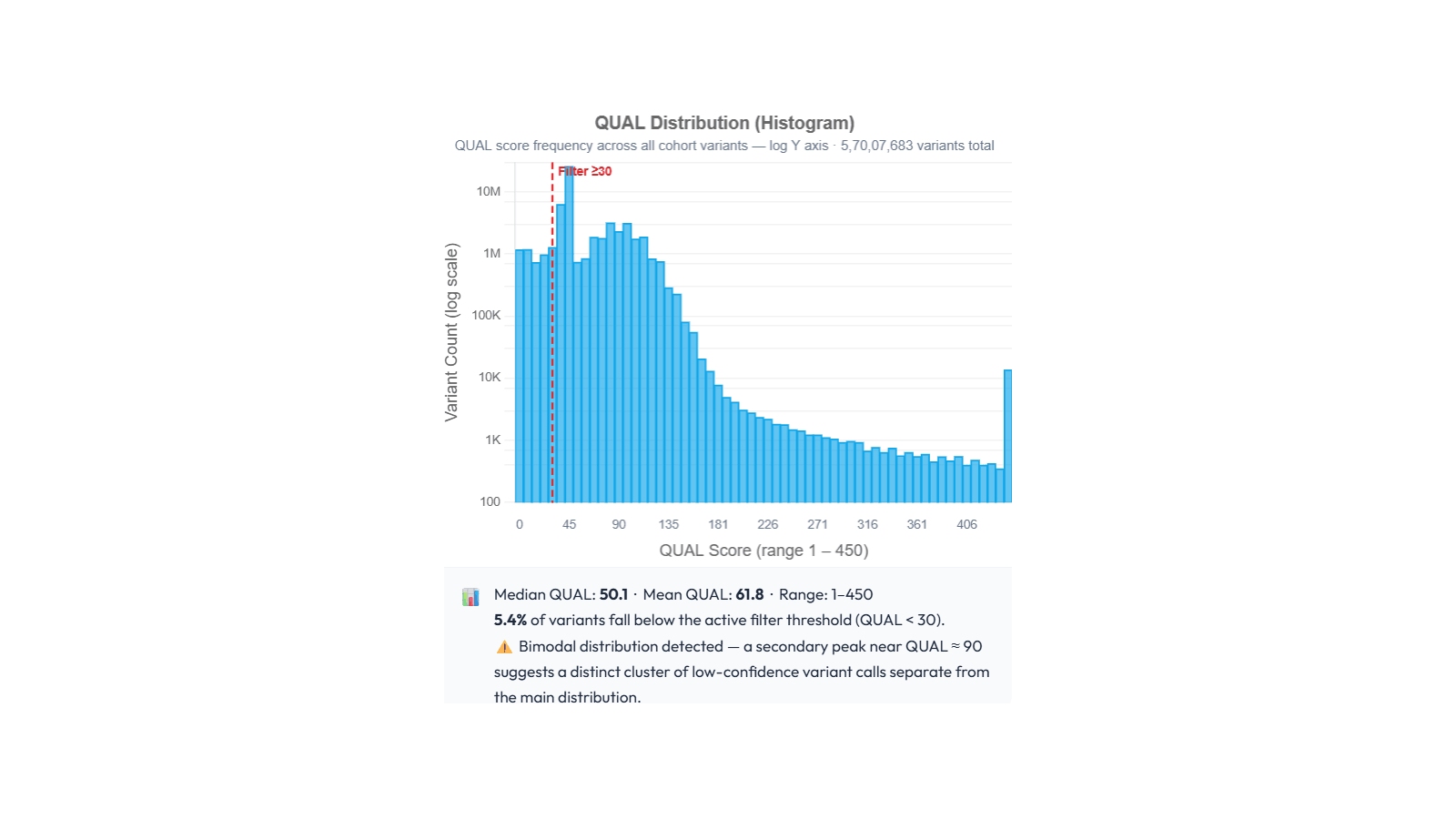
- Variant quality. The median QUAL score is 50, and only 5.5% of variants fall below the threshold of 30, with low-confidence calls forming a small, clearly separate group.
Finally, outlier detection asks a stricter question: does any sample deviate from the cohort on several quality dimensions at once, rather than just one? Flagging only those samples keeps attention on the cases that genuinely need review.
Consistent filtering, adequate depth, confident calls: the cohort is ready for biology.
Phase 2What defines the variation?
With technical confidence established, the questions shift from "can we trust it?" to "what does it tell us?"
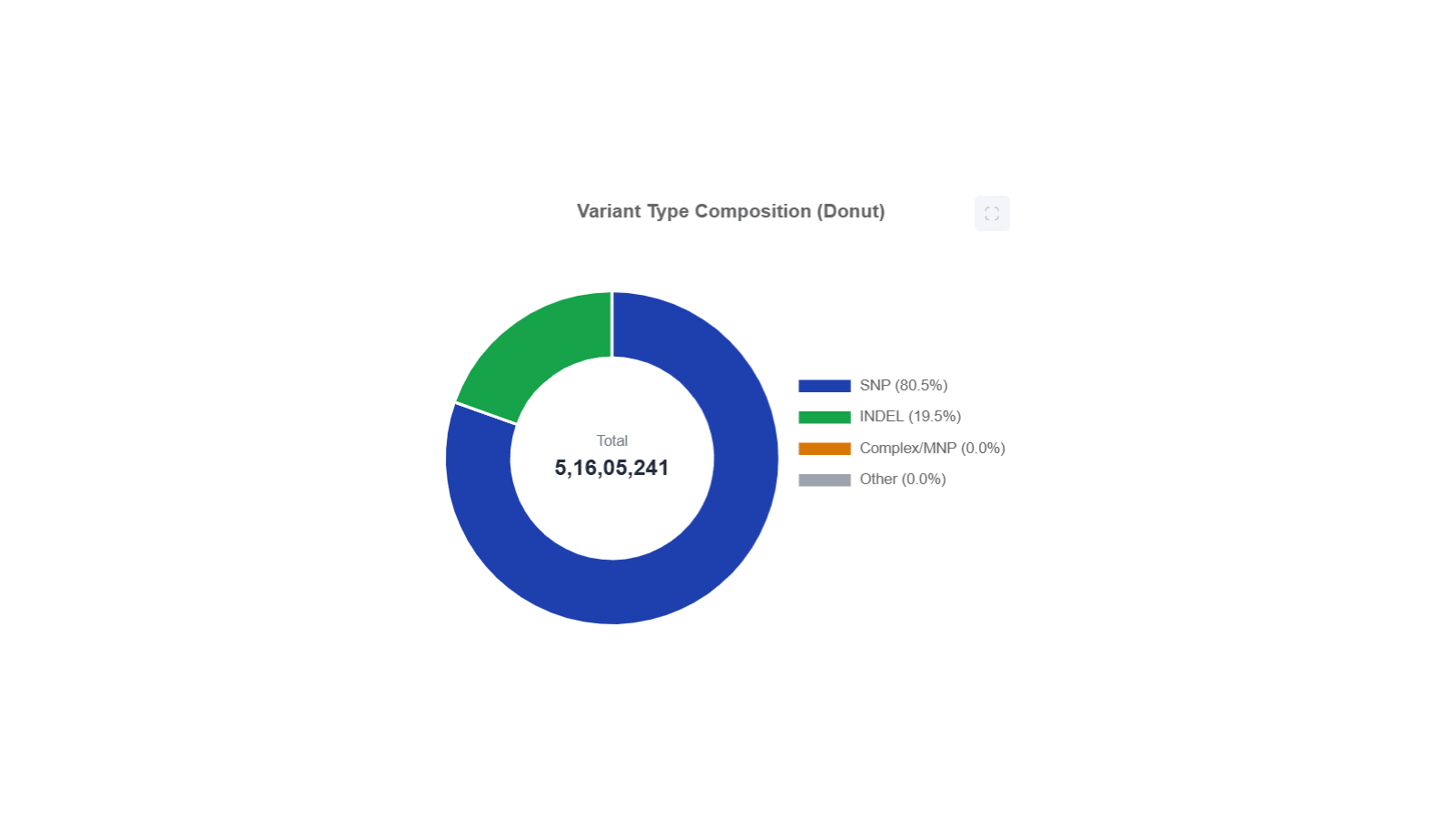
- Composition. About 80.5% of calls are SNPs and 19.5% are INDELs, the balance you'd expect from whole-genome sequencing.
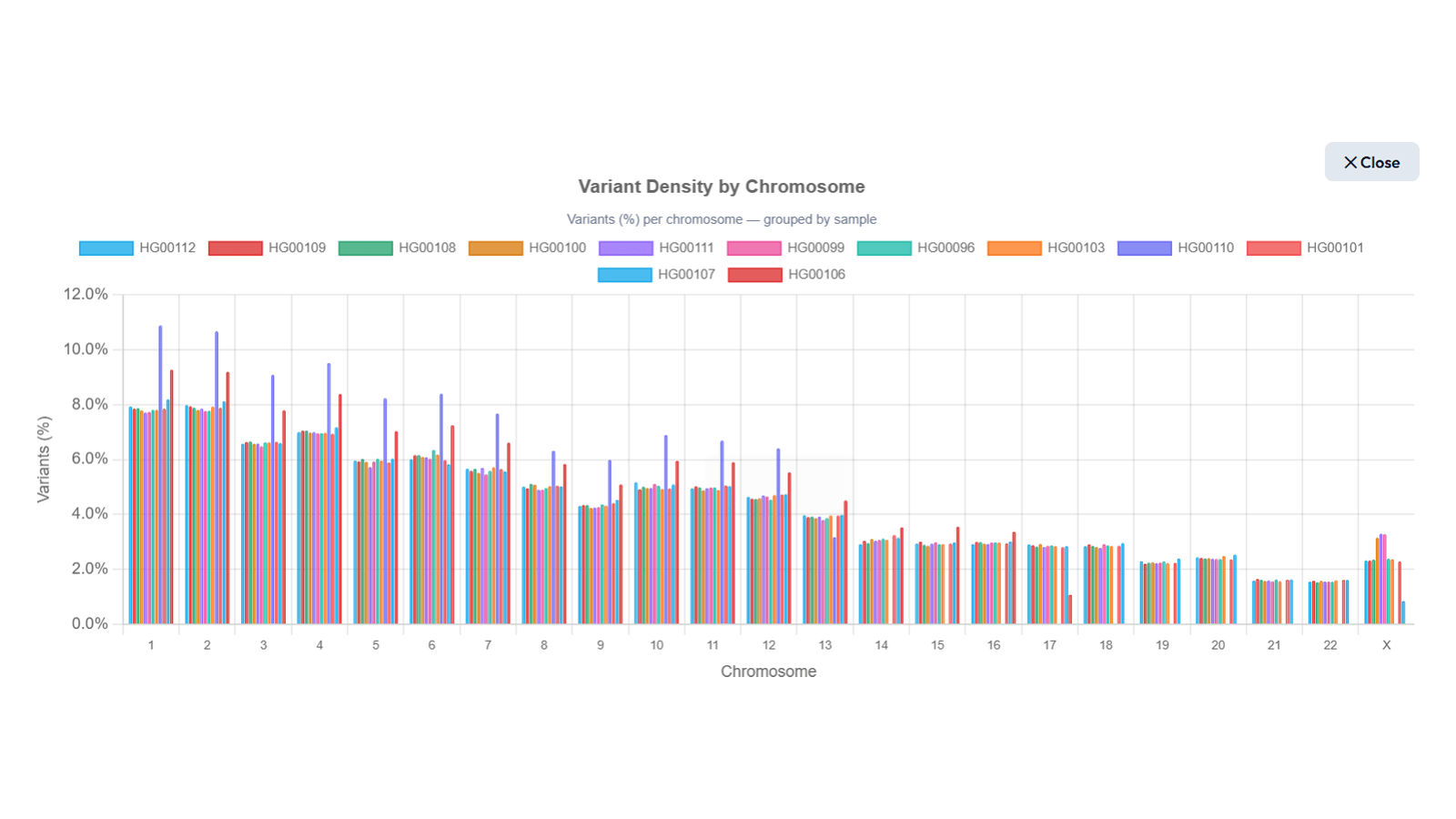
- Chromosome density. Chromosomes 1 and 2 carry the most variants, as expected for the largest chromosomes, but a few samples show chromosome-specific enrichment that stands out from the cohort.
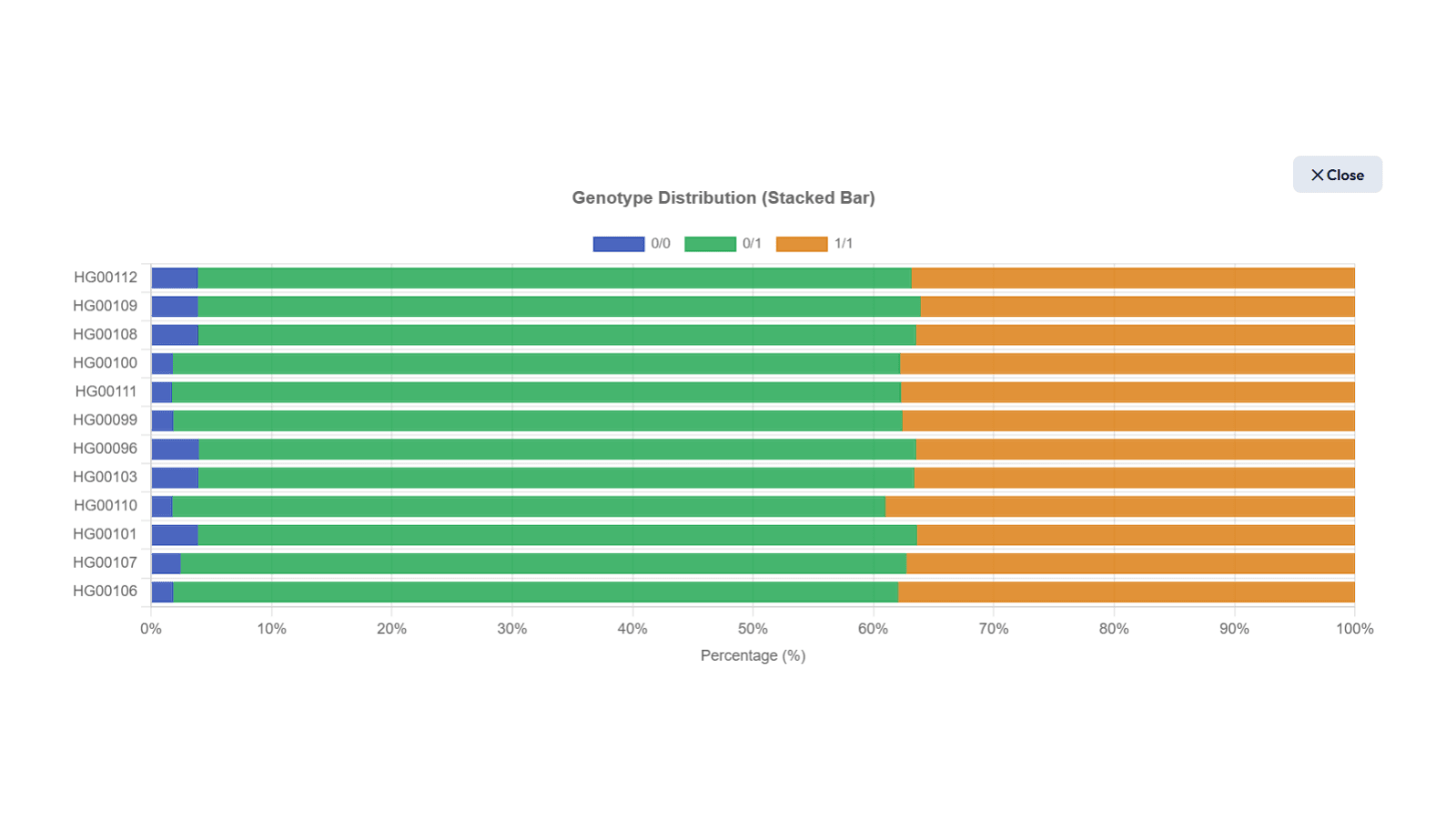
- Genotype structure. The balance of heterozygous and homozygous calls is consistent across samples, so genotype composition doesn't explain those chromosome-level differences.
- Runs of homozygosity. Here the differences appear: several samples carry extended homozygous segments across chromosomes 1 to 3, patterns that may reflect ancestry or population structure, and natural candidates for functional annotation.
In a handful of connected analyses, the workflow moves from millions of raw variant calls to a biologically interpretable picture of the cohort, ready for functional annotation, pathway analysis and discovery.
The platformWhat teams get
Natural-language queries
Ask in plain English; get caller-aware answers with biological context.
Automatic caller detection
7+ callers recognised from VCF headers, with the right thresholds applied.
Multi-sample cohort analysis
Select samples, switch to cohort mode, and 9+ comparison charts render automatically.
Scales from 1 to 500,000+
The same interface serves a single clinical exome and a population-scale biobank.
Traceable and reproducible
Every answer traces to its SQL, ready for clinical reports, audits and methods sections.
Honest about limits
The agent says what it can't answer rather than guessing.
Hours of custom SQL → answers in seconds
One pipeline per caller → one platform for all callers
Blockers at analysis time → limitations flagged up front
Ad-hoc scripts, lost findings → traceable, reproducible results
Working togetherFrom assessment to production
Variant Explorer is deployed into your own AWS account with CloudFormation and supported by Clovertex end to end:
- Assess. We review your VCF sources, callers, cohort sizes and annotation status, and return a readiness assessment and costed deployment plan.
- Deploy. The platform goes into your AWS account, your first samples are loaded, caller profiles are validated and dashboards confirmed.
- Onboard. Researchers and clinicians learn to query variants, compare cohorts and interpret results; custom caller profiles are added if needed.
- Evolve. We stay engaged: tuning query performance, adding callers and expanding agent capabilities as your data grows.
A small environment (a handful of samples from a single caller) can be up in about a week end to end; population-scale environments with mixed callers take four to six weeks, including validation, benchmarking and user acceptance.
What's nextYour variants, in plain English
Variant Explorer isn't a generic chatbot bolted onto a database. It was built for the structural complexity of VCF data: caller-specific quality fields, map-encoded INFO and FORMAT columns, and the need to scale from one patient to half a million. The agents understand the data; your team owns the insight.
If your team spends more time writing variant queries than interpreting them, we'd be glad to show you Variant Explorer on your own cohort.